
The last time I played GTA was in 2004. It was San Andreas.
Now, an imaginary tale.
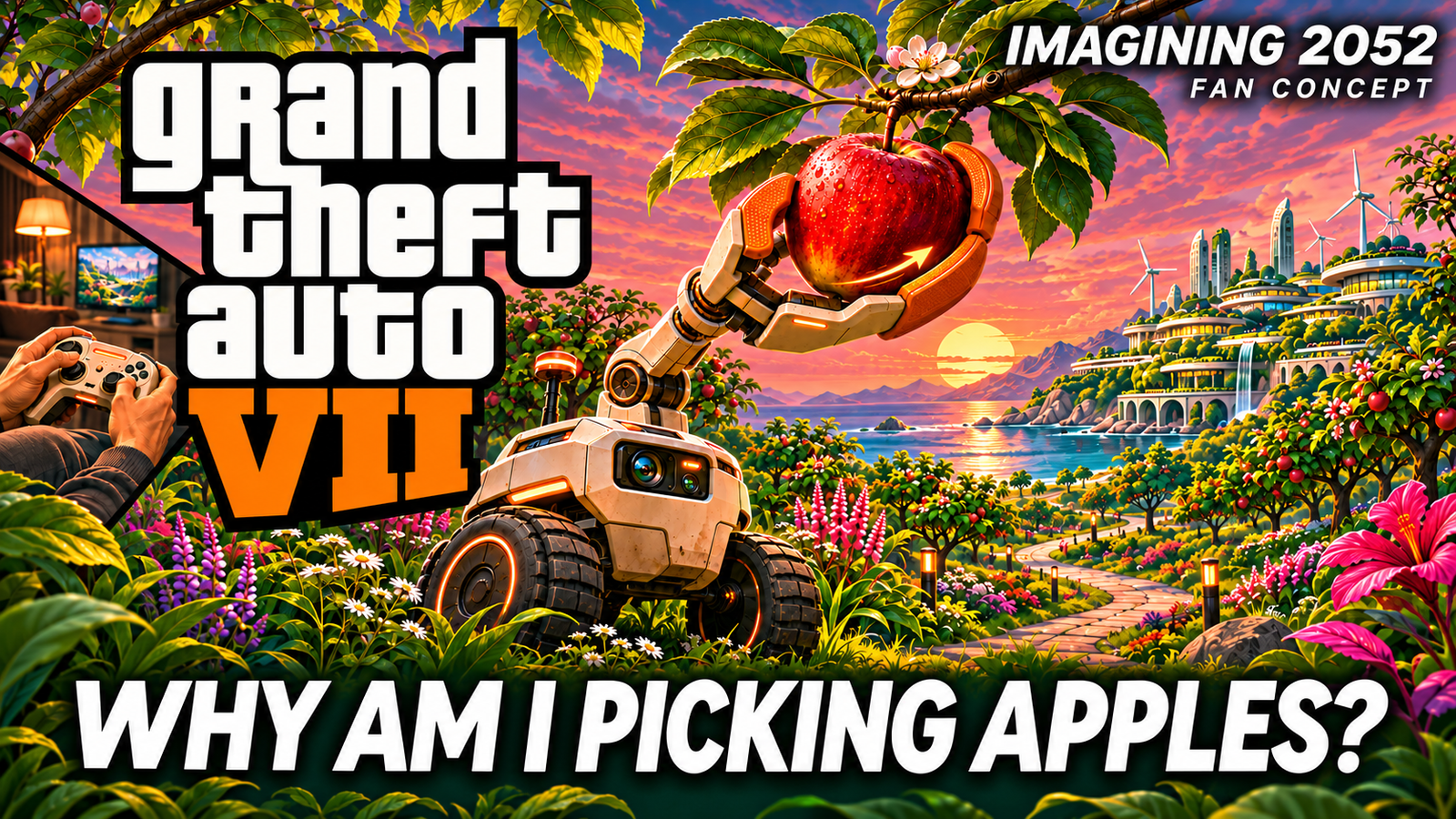
It’s 2052. I’m on my sofa when I feel an apple stem snap in my hands.
That’s my PS10 controller giving me haptic feedback.
In 2026, I ordered groceries through a screen. Now I can reach through it, into a parallel world where playing GTA has become part of everyday life.
A few minutes earlier, I’d noticed my wallet running low. I opened the map, looked for paid jobs and found a harvesting mission offering 100 satoshis. Enough for the week’s spending.
I drove there in the game, connected to a robot and found myself in a biodynamic food forest on the other side of Earth.
Through the robot’s cameras, I can see ripe apples tucked behind leaves and pears hanging among taller trees. Its sense-making AI identifies ripe fruit, suggests the optimal picking route for each one and navigates the undergrowth autonomously. The gripper moves gently between branches. Its harvest plan leaves food for wildlife and works around nesting places.
I’m the agency holder. I choose the mission and authorize the work, with the robot acting on my behalf. I remain available when a decision needs human judgment.
From a nearby tree, I choose an apple for myself, too. I put my name on it and feel the stem release through my controller.
The robot registers my order and triggers a microtransaction from my wallet to the forest steward’s blockchain address.
That apple now has my name and destination attached to its harvest record. Every fruit going into the basket has its own buyer and somewhere to go.
As the harvest moves through collection, packing and delivery, each completed step releases payment to the people and services involved. I can follow my apple’s progress while I carry on with my afternoon.
But I stay in the forest a little longer.
The agricultural fields and farms I remember from 2026 have become connected food forests and restored habitats. Apples, pears, nuts and berries grow among native trees. Underneath them are herbs, bushes and wildflowers.
AI, robots and a new generation of internet connectivity have removed the harvesting constraints that favoured monocultures in 2026, allowing us to gather food wherever it grows.
The paths follow the terrain. Some curve around old roots or protected patches of undergrowth. Roots hold the soil, wetlands retain water, and pollinators move through continuous corridors connecting the forest to the wider landscape.
Beyond the canopy, cities grow food on rooftops. Precision growing and fermentation supply more of what we eat, giving other land space to recover.
The systems coordinating this world measure soil health, water use and biodiversity alongside yield. A patch can rest when it needs to regenerate. The robots adjust their harvest plans around that decision.
I meet some of the people caring for the forest through the game. They can show me which planting areas are recovering, where water has returned and what they want to try next. The price of my apple helps pay for their work.
Following that one piece of fruit brings me back to an idea I explored years ago.
At an event I organized on gaming, finance and blockchain, I shared an early version of what an interconnected in-game life could be. I imagined a world so connected that you could log into a game, do real work and get paid for it, even if the work was happening on another planet.
This is how I imagine it feeling.
I can wander through a forest thousands of kilometres away, meet its stewards and choose dinner while playing GTA. I can also take a paid mission helping plan a restoration project, teach a robot a delicate repair or coordinate deliveries. My earnings arrive in my wallet and pay for my groceries.
Routine work runs autonomously. People contribute judgment, care and local knowledge. Someone with limited mobility can help manage a landscape they could never physically reach.
Living this much of life through a game still feels a little dystopian.
The Earth seems healthier, though.
Between taking Lucia to her dermatologist and ordering a coffee in an in-game café, I check the available missions again.
The café sends my order to a physical location, where my personal delivery drone can collect it. Meanwhile, I find an irrigation inspection in a greenhouse on Mars.
That job pays much more, and I’m qualified for it.
I queue the inspection and authorize the robot to begin. It works locally, then sends its report across the interplanetary delay. I’ll review the findings when they arrive.
My afternoon has taken me from a living forest to another planet. I’m still home in time for dinner.
A delivery robot arrives with the neighbourhood’s grocery orders. It brings bread, greens and the exact apple I chose in that distant forest, then collects reusable containers on its return trip.
By dinner, the apple is on my plate.
I recognise the little mark on its skin that I saw through the harvesting robot’s camera. For a moment, I picture the branch it came from, the path beneath it and the people tending that ecosystem.
Then I remember something else we’ve been waiting for.
There was a 13-year gap between GTA V and GTA VI.
I doubled it. It’s now 2052. Surely 26 years would be enough.
The quantum computer on my wrist has just helped design a new battery chemistry while my coffee brewed. I give it one more question.
“After 26 years of waiting, when is GTA VII coming out?”
It answers in milliseconds.
“Still no release date.”
Back to GTA VI.