
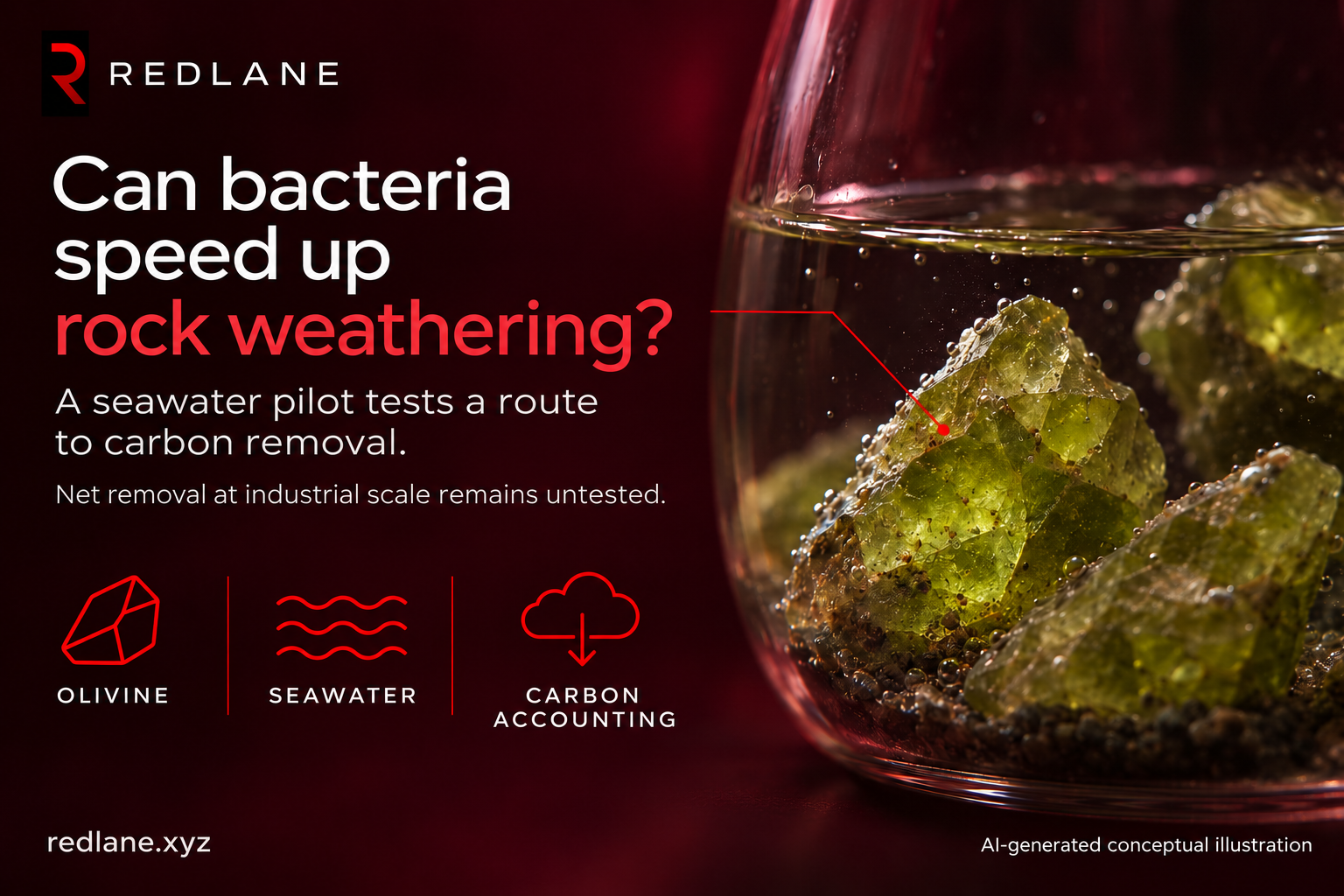
Four kilograms of green olivine sat in a tank of seawater. As the mineral dissolved, it changed the water’s chemistry. From that change, Neil Dalvie and colleagues estimated that their pilot reactor could remove half a gram of carbon dioxide from the air per day during one stretch of the trial. [1]
What the bacteria changed
As olivine weathers, iron can collect on the surface and slow further dissolution. The team used marine bacteria that help keep iron in solution. In a small experiment, olivine exposed to the engineered bacteria dissolved 2.6 times as fast as it did in a control without cells. [2] [1]
In the larger pilot, the researchers tracked alkalinity, a measure of how much acid water can neutralize. Increasing alkalinity lets seawater take up more atmospheric CO₂ and hold it in dissolved forms such as bicarbonate. The team converted its measurements from days 36 to 48 into the estimate of 0.50 grams of CO₂ per day. That figure describes gross uptake, before accounting for emissions from running the system. [1] [3]
What a coastline makes harder to measure
In a tank, researchers can sample the water entering and leaving. Along a coast, currents carry grains away and dilute the chemical changes left behind. If a grain disappears from a sampling site, how do you tell whether it dissolved or simply moved?
In a separate laboratory study published on 18 November, Alexander Milde and Lennart Bach tested an idea for answering that question. They paired olivine with fluorescent grains they could count under a microscope. The olivine raised the water’s alkalinity. But when the researchers counted the tracer grains again, there appeared to be more of them. They suspected that clumps had broken apart. Without a reliable count for comparison, they could not use the tracer to calculate how much alkalinity the dissolving rock had added. [3]
The REDLANE perspective
The pilot’s performance also changed with time. After about three weeks of feeding, microbial films built up and alkalinity production fell. The authors’ estimate of 74% more net removal came from comparing two hypothetical industrial reactors, one with engineered bacteria and one with seawater alone. It depended in part on the emissions associated with supplying nutrients and pumping water. [1] [2]
We’d look first for a longer operating record. How much CO₂ does a reactor remove across an entire run, including the weeks when its output falls? What remains after counting the energy and materials it consumes? Those numbers would let a reader judge the climate value of making a rock dissolve faster.